Friday, 2 June 2017

The Little-Known Personalization Strategy that’s Taking the Web By Storm (And How to Use It)

The Kissmetrics Marketing Blog
The Little-Known Personalization Strategy that’s Taking the Web By Storm (And How to Use It)

Marketers continue to embrace personalization and all its benefits. But in this day and age, greeting customers by their first name in an email is no longer enough. And lumping them all together based on demographics won’t cut it either.

Typically, marketing segmentation looks squarely at a user’s buying behaviors in trying to predict their next actions. But a new strategy, mindset segmentation, goes deeper. Let’s take a closer look:

What is Mindset Segmentation?

The term “mindset segmentation” was first used by marketer Kellie Cummings. She noted that:

“[m]indset segmentation identifies people based on their emotional desires and expectations […] Simply put, there’s more to customers than their willingness to purchase products. When employees see the human side of customers, they can develop communications that sustain customers’ trust.”

But mindset segmentation goes far beyond simply reaching out and building relationships with customers. It’s about getting to know your customers as people rather than just purchasers of your products or services.

So how do you do it? It’s important to note that in order to get the best use out of this type of segmentation, that you include — but also look beyond — the customer’s perception of your brand. Mindset segmentation can be broken down into the following attributes:

Beliefs

A customer’s beliefs can be boiled down to one simple question — what are the principles that drive them? Are they more independent or introverted? Do they tend to feel that life is an adventure, or are they happiest when surrounded by a large circle of friends?

There is no one right answer — but rather that their core beliefs line up with your business’ values. A mismatch here can create a disconnect or a misalignment, most often expressed in the feeling that “the company doesn’t understand me.”

Hopes, Dreams, Fears

Much like understanding their beliefs, understanding people’s hopes and dreams can help you more closely align your business and marketing objectives toward helping them meet them. By the same token, knowing their fears can help you avoid disappointing them. If something goes wrong, possibly the worst thing a brand can do is bury their head in the sand and hope the customer firestorm passes.

But by doing this, you’re making a statement that in turn, whittles away at their trust in you and their perception of you (more on that below). All too often, companies claim to be champions of the consumers, but when words and actions collide and the customers’ fears are made real, there’s a very distinctive “us versus them” division.

On the other hand, getting this right, and working with it responsibly is an open invitation to exceed your customer’s expectations and utterly delight them in doing so. And that’s the kind of trust and consideration that simply can’t be bought.

Expectations

What do customers expect from you and how do you live up to that standard? Many companies claim to support the customer and go “above and beyond” — but seldom do. Consumers of all backgrounds want to be perceived by friends, colleagues, and others in a certain way. How does your brand help them do that?

When understanding a customer’s expectations overall (and not just in relation to your company), it’s important to look closer at their beliefs and their hopes, dreams and fears. What will they absolutely NOT stand for? What values does your company represent that they feel comfortable in aligning themselves with?

In a similar vein, many people talk about “lifestyle brands” — brands that evoke such a powerful feeling that there’s an entire perceived lifestyle around them. One need only mention “Apple”, “Burberry” or “Quiksilver” to realize just how much of a role these brands play in shaping the culture and perception of those around us. Even if you’re not a high-end techie, an upscale Londoner or a surfer, you’ve likely seen these brands and the people who embrace them. Whatever opinion you have of them, there’s no doubt that they are living up to their customers’ expectations.

Emotional Needs

One may not instantly correlate a brand with a customer’s emotional needs not being met – but it affects their decisions more than you might think. Many financial decisions are affected by a customer’s self-esteem and their need for security and love. They have a direct, open need to be admired and liked, or to feel beautiful or be seen as hip or smart.

Whatever the need is, you can’t just plaster up a fancy presentation about how your company is meeting those needs. Customers want, more than anything, to be involved and feel important. Engage in conversation, not monologue. When people perceive your parent company as one that listens, understands and takes steps to maximize customer satisfaction, that company becomes a part of the customer’s lifestyle.

Brand Perception

How do customers see your brand? Beyond that, how would they describe your company to their family and friends? If you think your brand doesn’t have a perception, then you haven’t been monitoring the conversation. You’ll know if you’re doing mindset segmentation right, because you’ll go from a company that the customer recognizes, to one that they want to integrate with and use to reflect who they are.

Getting Started with Mindset Segmentation

The great thing about mindset segmentation is that it’s easy to work with. But it’s also worth understanding that not every customer will fit into these neatly packaged imaginary boxes or categories you’ve created — and that’s fine. Those are where mindset segmentation ends and persona creation begins.

Start by interviewing your most loyal customers. Touch on all the points mentioned above in a way that isn’t intrusive or annoying. Do more listening than speaking, and you’ll be amazed at what you hear. Take time to collect all the meaningful data you can about these people in a way that’s open and communicative. These people are going to be the linchpins of your mindset segmentation initiative. They’re going to be the people who drive the creation of your marketing personas and help shape your brand.

But interviews are just the tip of the iceberg. You can conduct polls and surveys, encourage users who like you on social media to also subscribe to your email list (and give them a reason to want to do so) and vice versa.

And it should go without saying that mindset segmentation isn’t going to replace market segmentation — but rather complement it. By using both tactics together, you’ll create a strategy that’s rooted in personal attention, yet still has a finger on the pulse of the industry and consumers as a whole.

Put simply, mindset segmentation is another facet of data that you can explore to give your customers a truly customized, personalized and influential experience with your company — and that’s the kind of interaction that every brand strives for.

Are you using mindset segmentation in your own marketing initiatives now? How is it working out for you? We’d love to hear your thoughts and get your perspective. Why not leave us a comment below?

About the Author: Sherice Jacob helps business owners improve website design and increase conversion rates through compelling copywriting, user-friendly design and smart analytics analysis. Learn more at iElectrify.com and download your free web copy tune-up and conversion checklist today!

Thursday, 1 June 2017

What is Kissmetrics Campaigns?

The Kissmetrics Marketing Blog
What is Kissmetrics Campaigns?

A few weeks ago, Kissmetrics CEO Brian Kelly announced the new phase of Kissmetrics – Customer Engagement Automation.

Customer Engagement Automation (CEA) is a platform that allows marketers and product teams to fully understand and drive customer engagement. It combines person-based digital analytics with scalable, engagement messaging.

Along with the CEA announcement, we released a new feature called Campaigns. With Campaigns, customers can send automated, triggered emails based on their user’s behavior.

Using our analytics platform, you’ll identify the segments in your user base that need some nudge. Whether it’s to get them to sign up, log in, use your product, etc. You’ll identify this segment with one of our reports, then use Campaigns to nudge them.

To best understand the value of Campaigns, let’s first discuss some common use cases for SaaS and E-commerce companies.

Campaigns Use Cases

Campaigns was created for marketing & product teams to help them acquire, engage, and retain more of their customers. Here’s some campaigns that SaaS and e-commerce companies can set up:

E-commerce: Abandon Cart email – Seeing customers are dropping off before purchasing? Send a triggered email to nudge them toward completing their purchase. Follow-up Purchase – Stay on top of mind by sending customers a post-purchase email a week after making their purchase. Personalized Product Offers – Selling a new product a segment of your customers will be interested in purchasing? Send an automated email to these users with an offer, then track it all within Campaigns. Re-engagement Emails – E-commerce companies thrive on repeat purchases. Set up an automatic email to go out to customers who don’t purchase after x amount of days with an offer to come back and purchase. Reward Loyalty – Segment your loyal customers by emailing them additional offers or free upsells on their next purchase. SaaS: Abandon trial users – Keep trial users engaged and increase the odds of a purchase by sending them an email to login and discover the value of your product. Inactive paying users – Prevent churn by sending triggered emails to users after they haven’t logged in after a certain amount of time. Feature Announcements – Send emails to all or a segment of your users who would be interested in using a new feature. Re-engage users – Email users who complete a part of your onboarding or feature usage but drop off before completing.

All these emails can be triggered to send within Kissmetrics. Identify the users that need more engagement, and then create a campaign to nudge them towards conversion.

Use Case: SaaS Company Struggling to Convert Trial Users

Let’s say you’re the Director of Growth for a mid-sized SaaS company. Your job is simple but challenging: grow the company. Acquire and keep more customers. You spend all day interpreting data and optimizing all stages of your funnel.

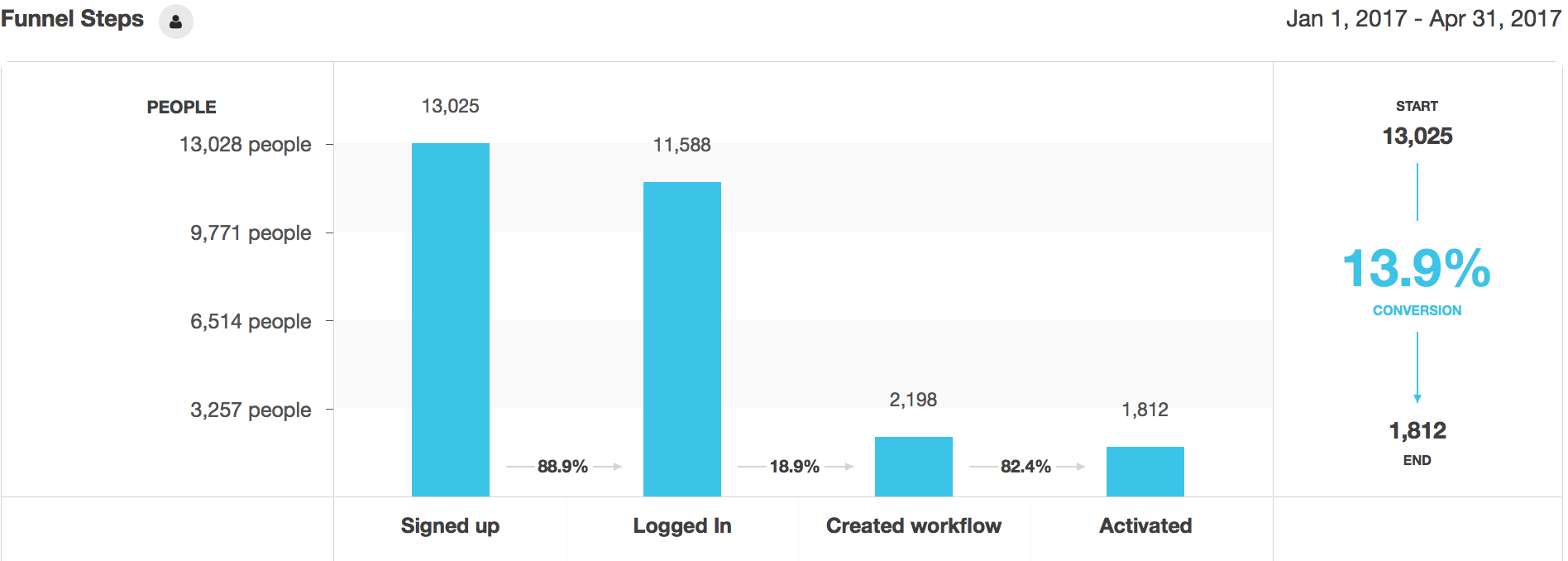
You use the Kissmetrics Funnel Report to track onboarding. These are all the trial users who have signed up and are currently working on getting set up and accustomed to using your product. After signing up and logging in, users begin the onboarding process by creating a workflow. Once they do that, they take an additional step by activating a part of the product.

Here’s what the funnel shows you:

saas kissmetrics funnel

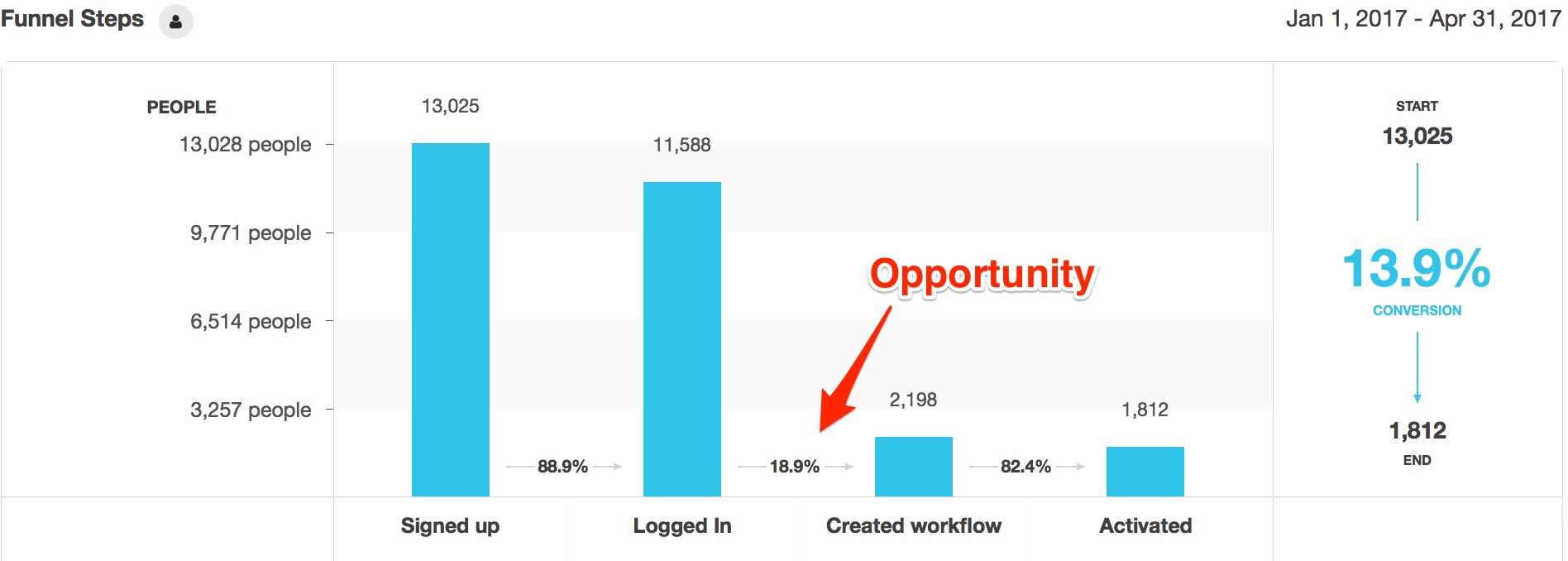
The dropoff is clear:

opportunity in kissmetrics funnel

The weak part of the funnel is getting people to create a workflow. You move more people to creating their workflow, and it’ll have downstream effects on the rest of your funnel – after that it converts at 82%.

To nudge people towards creating a workflow, we’ll create a Campaign that sends them an email once they’ve logged in but have not created a workflow. To do that, we’ll create a new campaign and set the conditions.

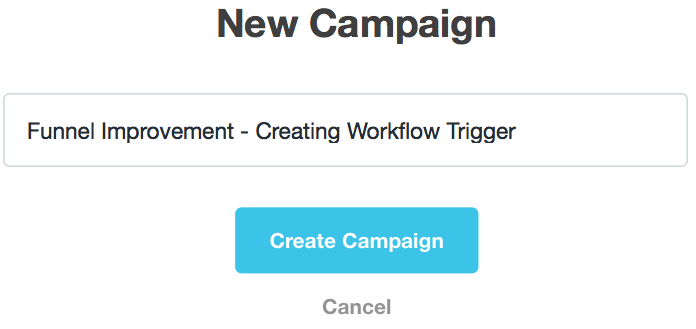
We’ll name the Campaign “Funnel Improvement – Creating Workflow Trigger”

kissmetrics campaign first step

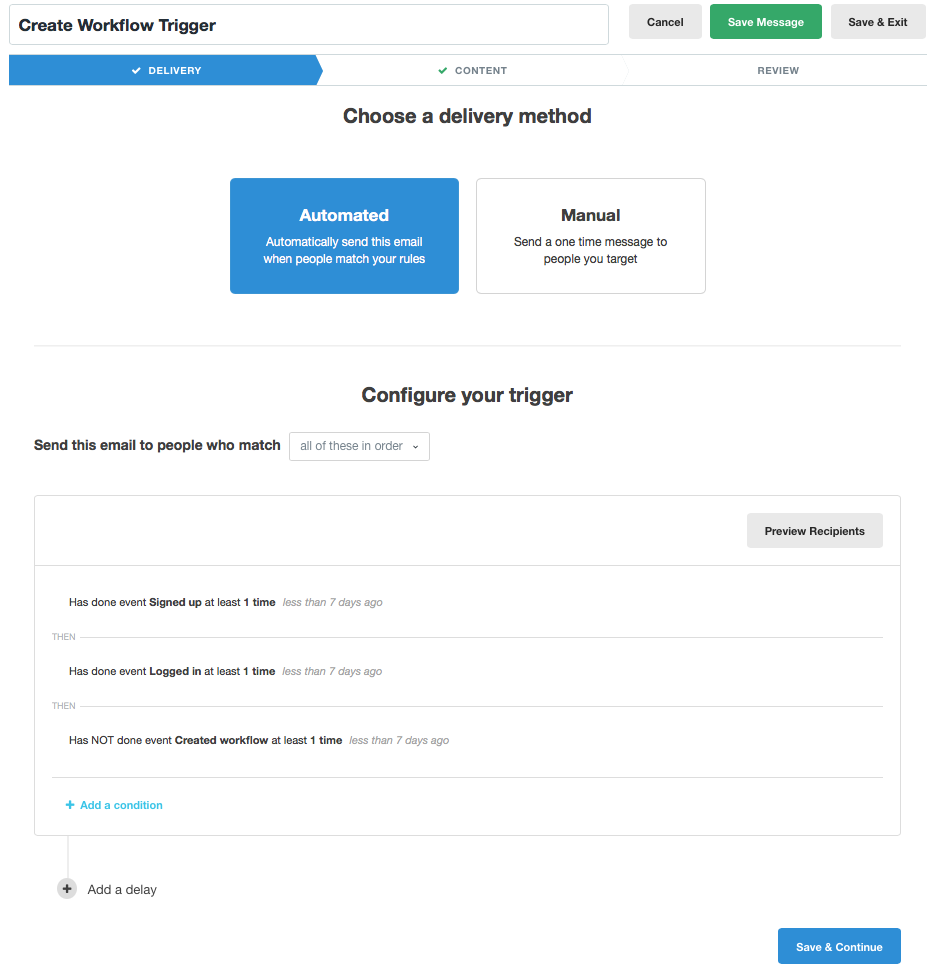
And we’ll set the conditions for the first email – triggering for people that have signed up, logged in, but have not created a single workflow.

delivery and trigger kissmetrics campaigns

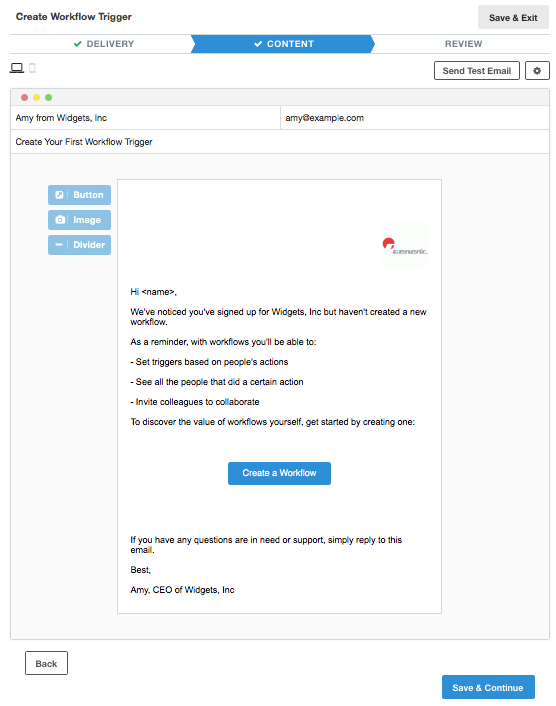
We have those conditions set, now we’ll create the email. Here’s how the editor looks:

kissmetrics campaigns content editor

We’ll create the copy for this email:

kissmetrics campaigns editor email

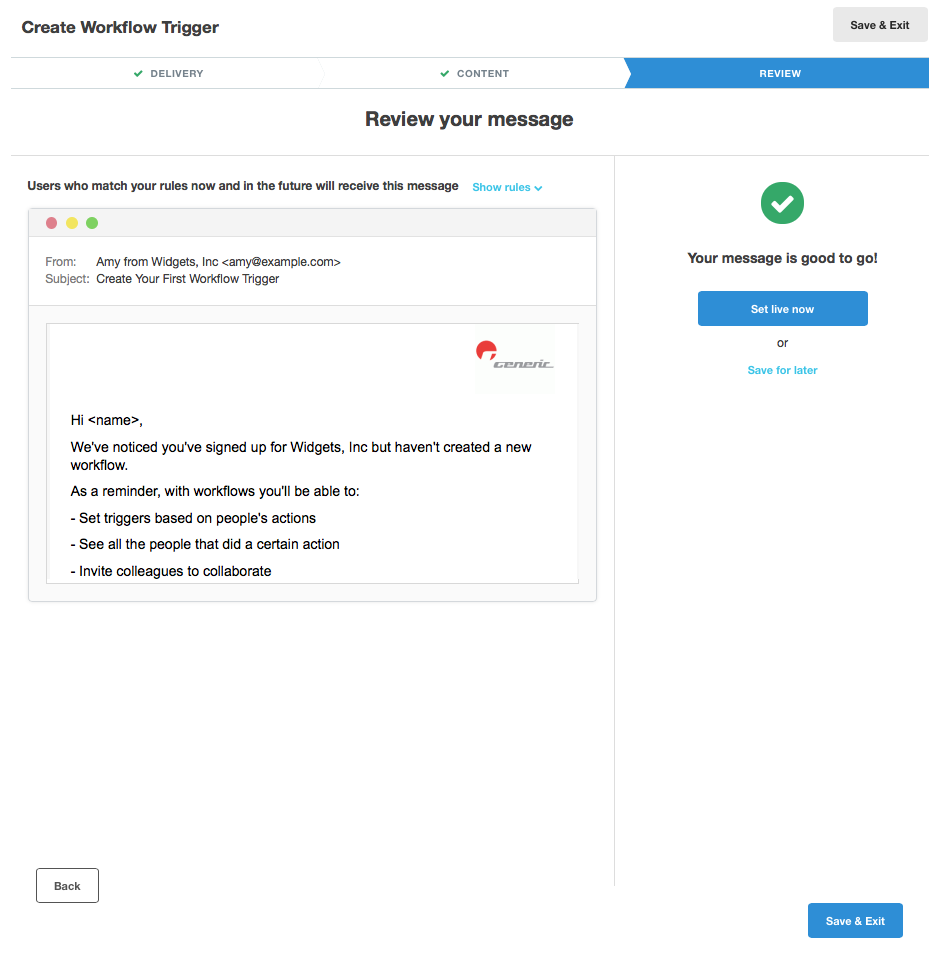
We’ll click Save & Continue and review the conditions and the email:

review kissmetrics campaign

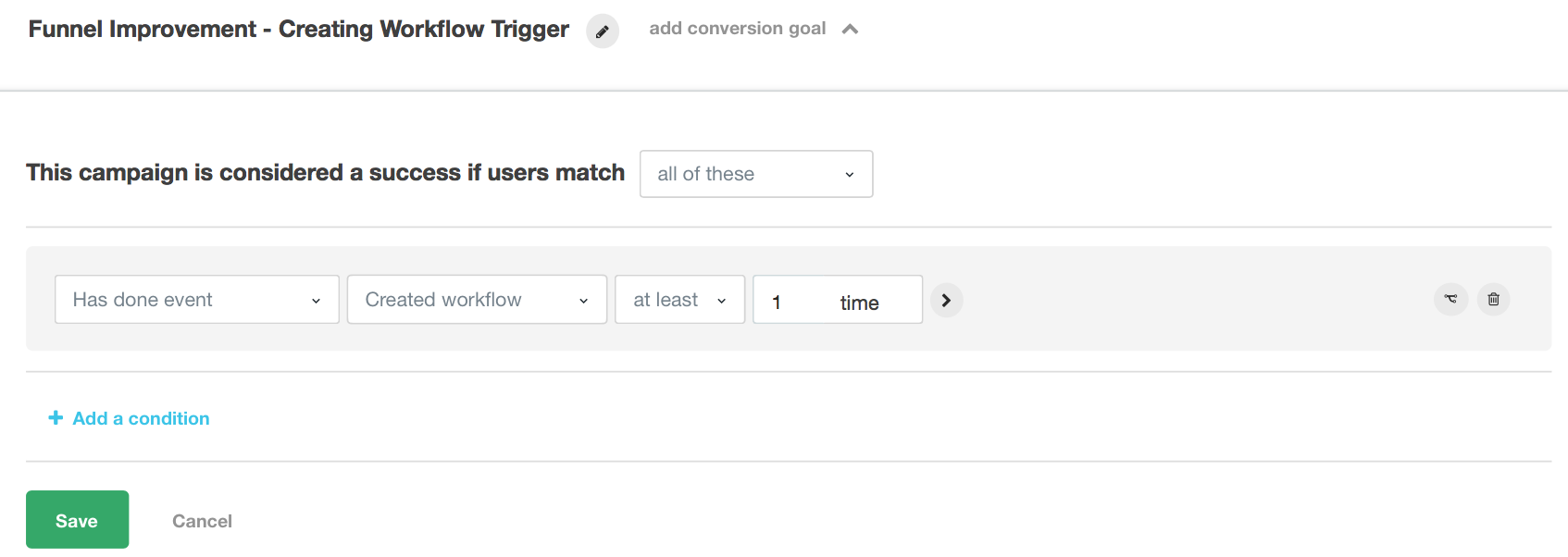
And that’s it! We’ll Save this message and it’ll be sent to those that fit our conditions. We’ll go back to the Messages page and set our Conversion goal as “Created workflow”:

conversion goal in kissmetrics campaign

And we’re set! That campaign will run and we’ll check in periodically to see how it’s performing.

Now onto the next optimization!

Conclusion

Kissmetrics pioneered behavioral analytics in 2009. Most analytics tools at the time only showed what was happening on your site. Kissmetrics was different because it showed you what was happening and who was doing it.

With CEA, we’re introducing the new phase of Kissmetrics be combining analytics with engagement to help you acquire, keep, and engage your customers.

If you’re already a Kissmetrics user, you can login and Campaigns will be available to you.

To get started with Kissmetrics, request a demo with one of our account executives.

About the Author: Zach Bulygo (Twitter) is the Blog Manager for Kissmetrics.

Wednesday, 31 May 2017

Getting Started with Behavioral Email Marketing

The Kissmetrics Marketing Blog
Getting Started with Behavioral Email Marketing

When sending out automated emails to your list, how personalized are they?

I’m not talking about things like $firstname, or order by $date for free shipping – but actual personalization based on their behavior.

According to MarketingSherpa, 39% of marketers found that sending emails automatically based on user behavior was their most effective email marketing strategy. At the same time, DMA reports that emails triggered by behavior were responsible for 30% of revenues in 2014, up from 17% in 2013, and that 77% of ROI comes from segmented, targeted and triggered campaigns.

Let those numbers sink in a minute.

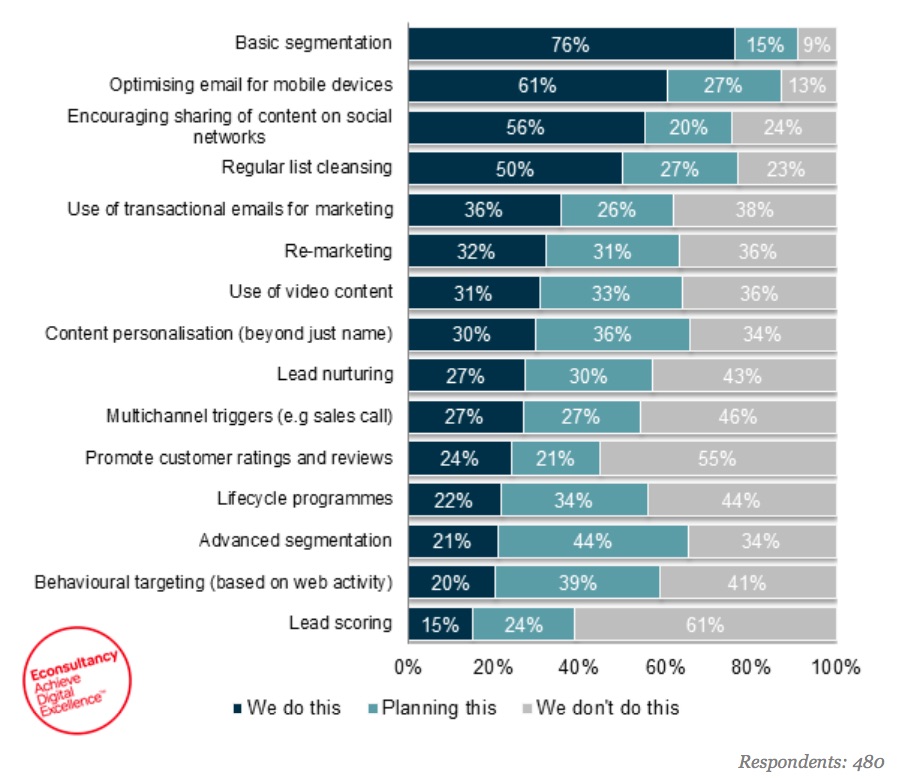
The potential for making the most of behavioral email marketing is wide open, and yet, according to eConsultancy, only 20% of marketers are using behavioral targeting.

email segmentation marketers surveyOnly 20% of marketers surveyed use behavioral targeting (Image Source)

Why is that? Let’s take a closer look at the core issues and learn how to get started with behavioral email marketing.

Getting the Big Picture with Behavioral Tracking

Oftentimes, marketers want to start behavioral targeting, but they have no idea how or where to start. The first step, if you haven’t done so already, is to monitor how people are interacting with your brand.

Kissmetrics can deliver this kind of invaluable behavioral analytics data. Like the brain of your behavioral marketing outreach, it seeks out and stores details about your visitors, including:

Who they are, and when they converted What they viewed, where they clicked on your website, and when they purchased Group visitors based on shared criteria Identifies where people are dropping off before converting Whether or not they submitted any forms, conducted any live chats, and so on

Because of this powerful people-based analytics platform, you can tailor your behavioral email triggers to suit precisely what your audience is looking for.

Decide Which Customer Actions Warrant an Email

Now, not all of these points will be email “action-worthy”, so it’s up to you to figure out what actions the user takes (or doesn’t take) that are worth sending an email. You may have even seen this kind of behavioral targeting at work when you sign up for a service, but don’t complete your profile or don’t verify your email address. If the company is smart, they’ll send you an automated email reminding you to do so.

But re-targeting the user in this way isn’t the only way to leverage behaviorally targeted emails. You can also send out targeted messages, for example, when a customer:

Submits a form to download your white paper, video, case study or other free item Views certain content on your web page. If they spent some time browsing the FAQ, you can set up a behaviorally targeted email to check in and see if they have any specific questions Leaves an item in their cart without checking out. You could send them a reminder email with a small discount, remind them of limited stock (or that their cart will expire) and so on

Remember, with behavioral email marketing, it’s the customer at the wheel — not you. They’re making choices while interacting with your content. Behavioral marketing is designed to act on those choices with the kind of engagement that increases conversion rates, grows profits and vastly improves customer retention.

Unearthing More Behavioral Email Trigger Opportunities

Once you start collecting and analyzing the information that you gather on your customers, new opportunities for behaviorally targeted emails will percolate to the surface. You’ll start getting all kinds of great ideas on how to guide users back into your service. To help get you started, however, here are some of my favorites:

The “Getting Started” Email

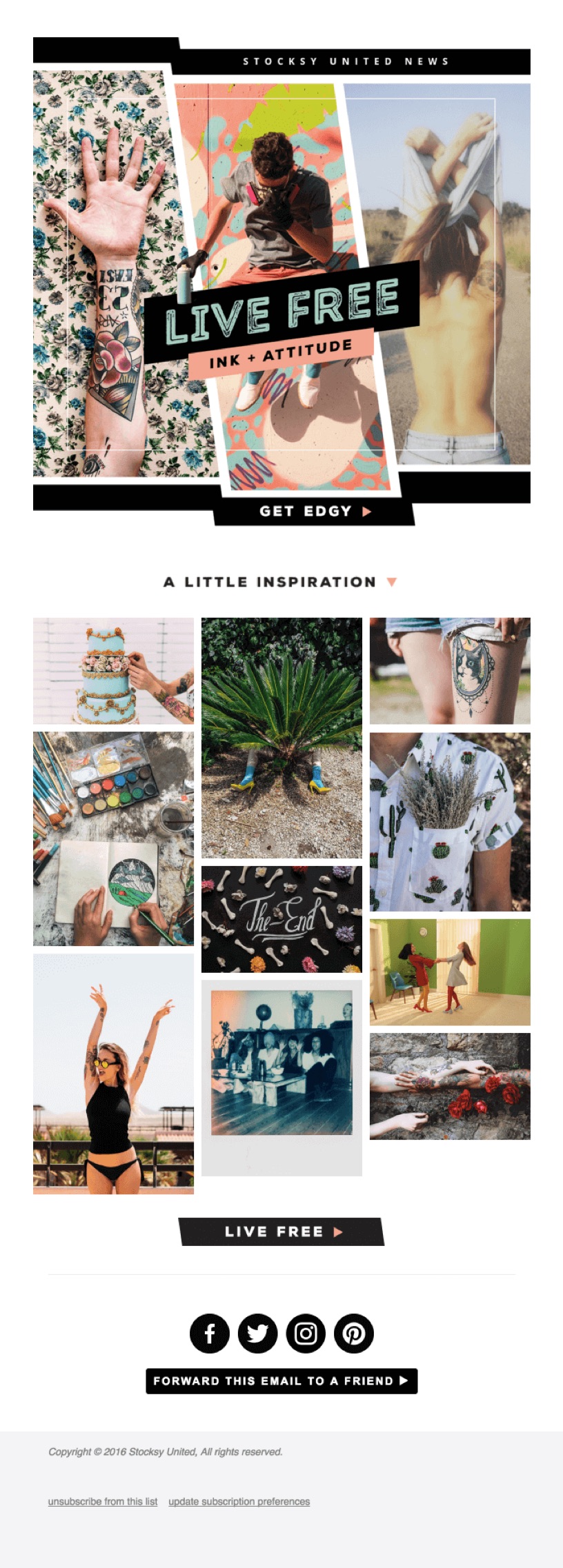
Also known as an “onboarding” email, this message is usually sent after you create an account or register for a service. It’s designed to get you clicking and interacting with the service as quickly and fluidly as possible. Here’s an awesome example from Stocksy, a stock photography site:

Image Source

Notice how they’ve carefully curated images on a specific theme – then encourage you to click through and check them out for more design inspiration. Here’s another example from Airbnb:

airbnb sonoma email giftImage Source

If you’ve been browsing trips to wine country, this targeted email can help make your tour much more palatable through the offer if discounts, local guides, special attractions and more.

The Notification Email

The notification email is generally just a canned response from your account or user management software that tells people their username and password, and maybe has a link to some documentation to get started. That’s where most of the getting started process ends — which results in a lot of confused or frustrated users.

Instead, encourage them to take the first step toward trying out your product by offering more of a guided, hands-on tour. If you have a SaaS, walk them through using it by helping them to create their very first _____ — such as a website, playlist or campaign. This sort of guided, pop-up tour will help them feel more at ease, and can also give you even more valuable data for your behavioral targeting goals.

The Icing on the Cake Email

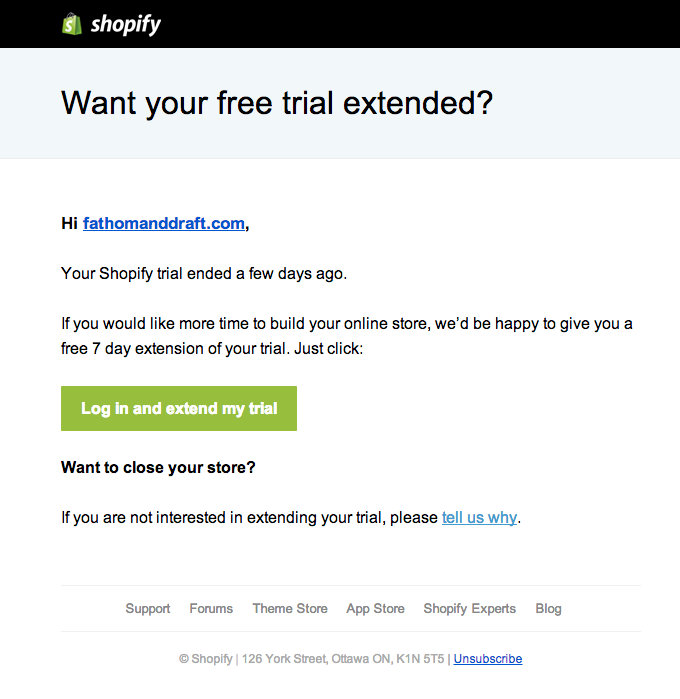
These are the unexpected but highly welcomed emails that encourage better customer retention. Here’s a great example from Shopify that lets users extend their free trial of the service:

shopify free trial extended emailImage Source

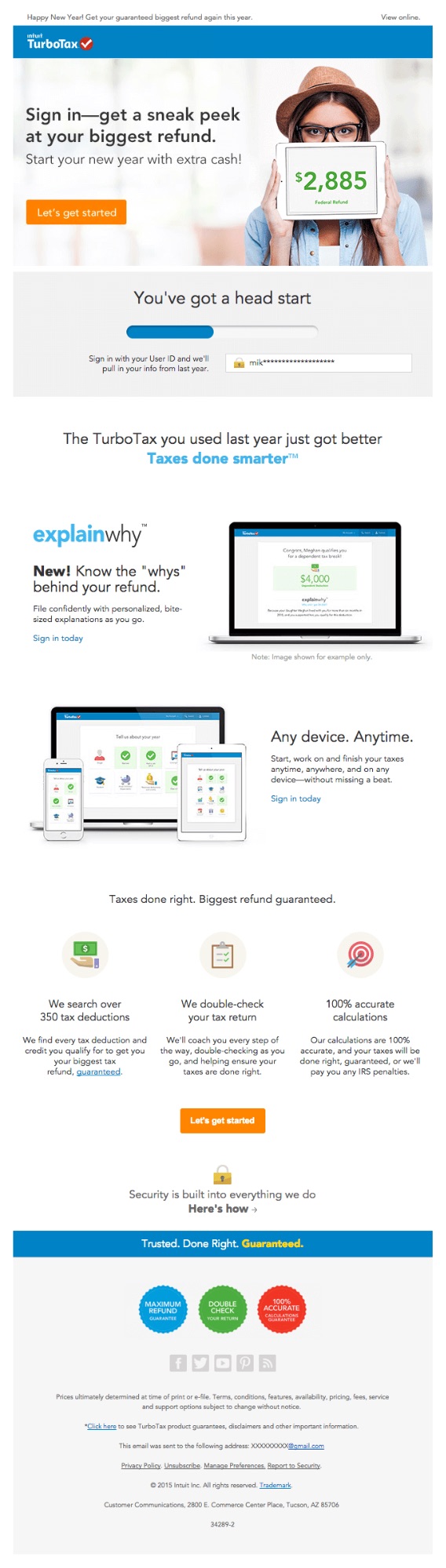
Another example comes from TurboTax, which is designed to pique the user’s curiosity about how much their tax refund could be, before they ever see a check in the mail:

turbotax sign in email notificationImage Source

It also promotes the benefits of using the TurboTax service, but without being overly “sales-y” or pushy. Rather it shifts the focus onto the customer and their end goals – which revolve around getting the biggest refund possible at tax time.

The Reward Email

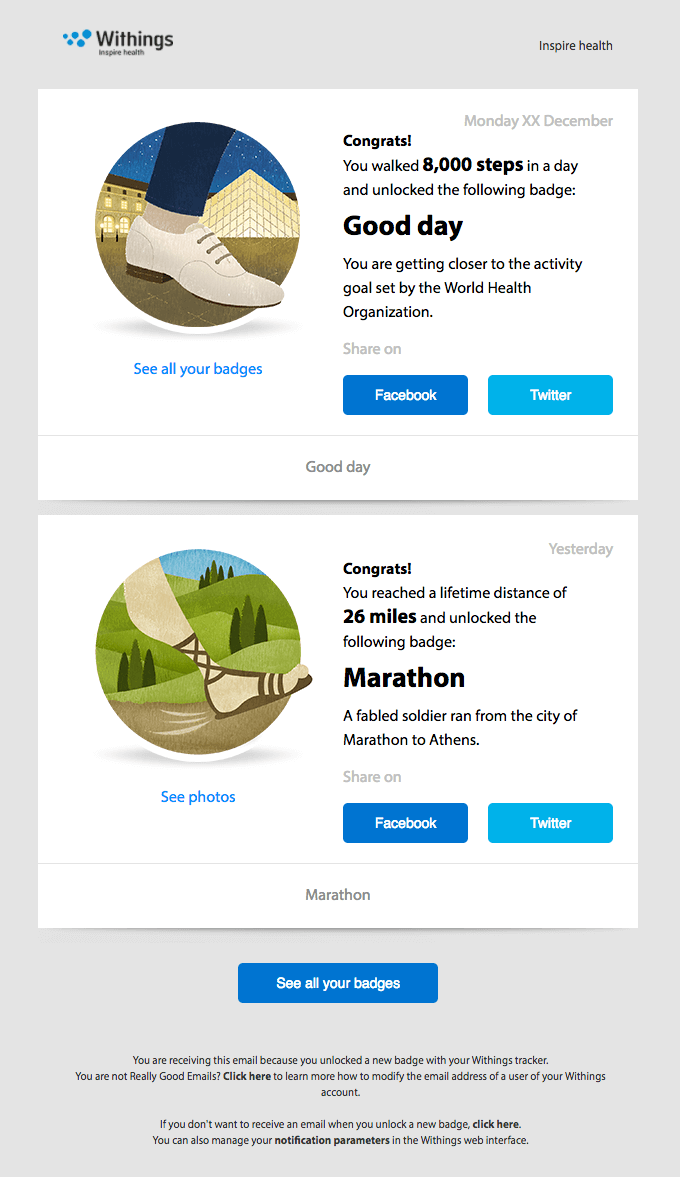
Everyone loves getting an unexpected reward — even if it’s a digital “good job!” Here’s an example of an email from Withings, which is a Fitbit-style product that helps inspire healthy habits by tracking your activity. Here, you can see a user has won a badge for taking 8,000 steps in a day, and unlocked the Marathon reward. They can also share their progress on Twitter or Facebook.

withings reward emailImage Source

The Recommendation Email

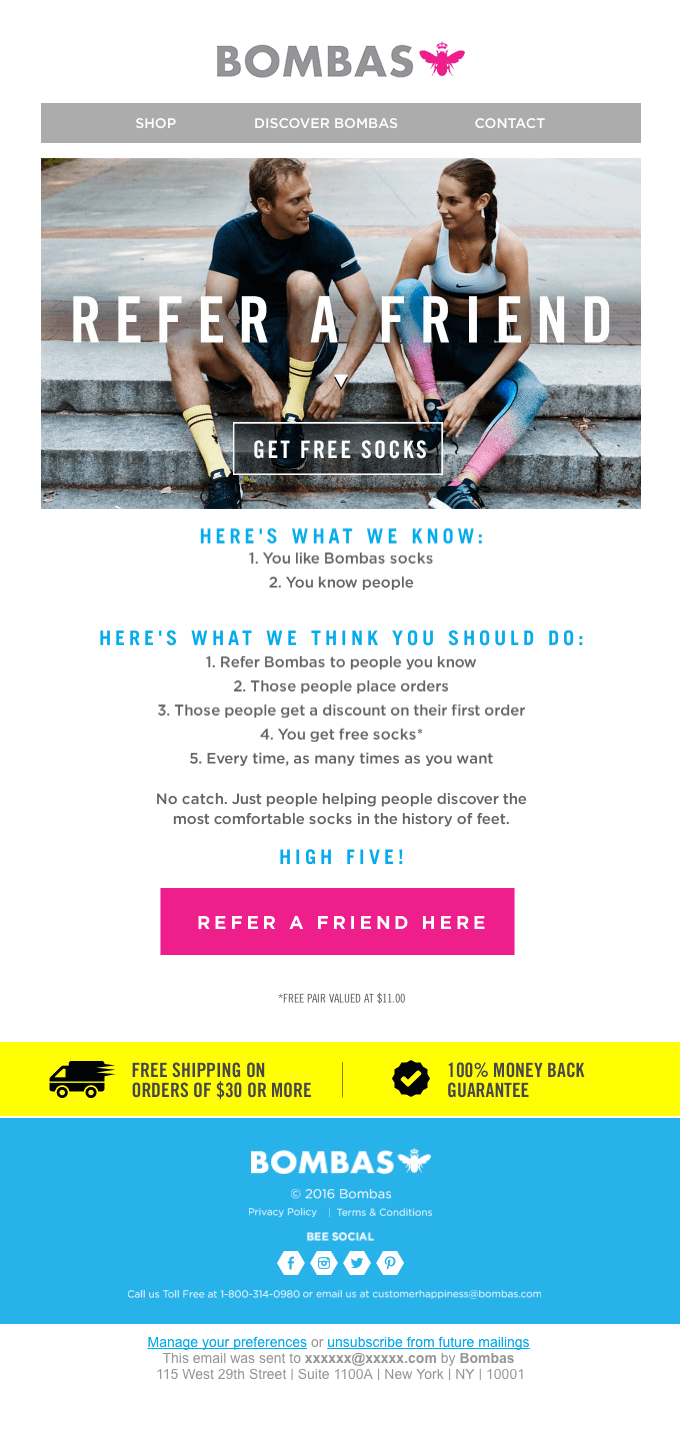
Oftentimes, great customer service from a company is enough to get you to recommend them. But what if the brand sweetened the deal? Bombas, which sells socks online, provides free socks, with no limit, to people who tell their friends about them. Those friends get a discount on socks, and the referrer gets more socks. And we all know you can never have enough socks.

bombas refer a friend emailImage Source

Transactional Emails

Did you know that transactional emails (receipts, shipping notifications, etc.) are opened up at 8x the rate of regular emails? With this in mind, it’s worth going through the ones your company sends and doing away with those dusty old “order confirmed” messages, to make every note you send one that not only thanks the customer for their order, but does so in a way that’s more akin to having a conversation than making a statement.

So Just How Do I Set All This Up?

Until now, behavioral email targeting was difficult to set up because so many pieces of technology had to communicate with each other. With the new Kissmetrics Campaigns, behavioral targeting via email (and other channels) is built right in, so you can customize precisely when automated emails are sent to your customers, based on their behaviors. It’s better targeting, discovery, engagement and retention all rolled into one.

Be sure to check out the detailed article link above to learn how to use this new feature to the fullest, and be sure to share your behavioral targeting email success stories with us in the comments below!

About the Author: Sherice Jacob helps business owners improve website design and increase conversion rates through compelling copywriting, user-friendly design and smart analytics analysis. Learn more at iElectrify.com and download your free web copy tune-up and conversion checklist today!

Tuesday, 30 May 2017

When ‘Fear’ Works & When it Backfires

The Kissmetrics Marketing Blog
When ‘Fear’ Works & When it Backfires

Fear works.

Except for when it doesn’t.

There’s no better way to force prospects to pay attention than by striking the fear of God into them. It interrupts patterns and interests the unaware.

But.

That doesn’t mean it always works.

In fact, in many cases using fear or negative messaging can actually backfire.

Here’s why, and how to do it correctly.

Why do we do what we do?

We used to be cavemen. Cavewomen too.

At least, that’s what science says.

In these primitive times, there was no cold brew. No netflix. No alco… well, there was probably something fermented of some sort.

But there were harsh conditions. The environment was unstable. And they were constantly surrounded by scary beasts.

So life was probably pretty straight-forward. Here’s the GTD ‘next action’ list of a caveperson millions of years ago:

Don’t get eaten. Don’t fall off a cliff. Find food. Fornicate. (Hey — we all got here somehow. This is science people!)

Today we’re not much different. Except monsters and cliffs have been replaced by bosses and email respectively.

Pain and pleasure are the primary motivators of human behavior. Humans gravitate towards pleasure while avoiding that which causes pain.

Fear is a stressor; a reaction to anything that’s threatening, dangerous, or likely to cause pain. Which explains why fear-based messaging has long been used in marketing and advertising: People don’t want pain. Triggering their fear for pain incites them to action.

A reported 25% of Americans have “high stress levels,” with another 50% reporting “moderate stress.”

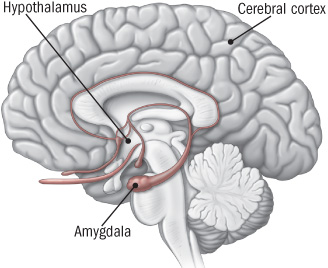
Stress signals can chemically alter your brain. Your emotional processor (the amygdala) sends bright, flashing WARNING signs to your critical command center (the hypothalamus), which instantly decides whether you should run like hell or suit up like a gladiator.

hypothalamus cerebral cortex amygdala areas in brainImage Source

But response to fear is highly personal, the same way not all fear are created equal. What George will run away from John may tackle with gusto. Different people react to the same stressful situation differently (or ‘fight’ vs. ‘flight’).

And here’s the kicker.

The Harvard Health Publications says that “chronic activation of [the ‘fight or flight’] survival mechanism” is bad for the health. You don’t want to be that company people associate with negativity. Therefore, incessant badgering of your target audience with fear-based marketing can be catastrophic for your company’s overall brand health.

Even though it almost always works in the short-term.

Does fear-based marketing work?

Yes. Fear-based marketing works.

(Wow that was easy. On to the next section…)

Just kidding, but seriously. It does.

Turns out Gordon Gekko was onto something: Greed, and its inverse, fear, does matter.

(What — you think the stock market goes up and down based on math alone? Don’t make me laugh.)

Inciting fear has been proven to be the absolute best way to grab attention. And in a world where millions of blog posts go out and trillions of emails are sent daily, grabbing attention is freaking critical!
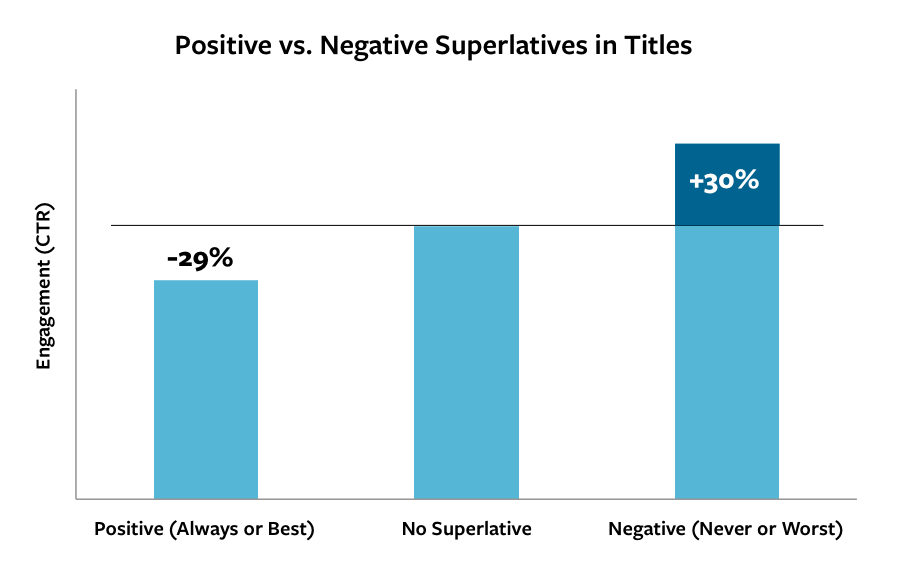
Exhibit A comes courtesy of ConversionXL which comes courtesy of QuickSprout (there’s a meta joke in here somewhere):

fear vs how to headline

The first subject line resulted in a 65% conversion lift. You see this so often that it’s not even surprising anymore.

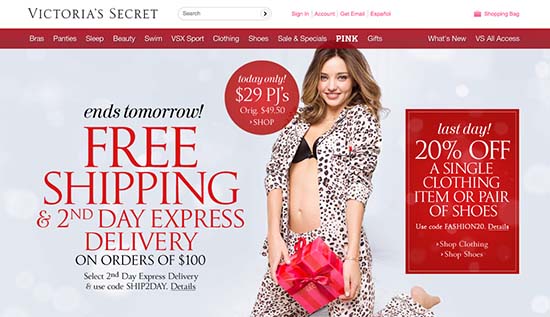
Here’s Victoria’s Secret emphasizing how long this deal is going to last — three times on the same page:

“Ends tomorrow!” “Today only!” “Last Day!”

victoria's secret 3 deals on one page

(Yes, this is just a bad excuse to conduct “research” on Victoria’s Secret’s website.)

So yes. Fear works.

There’s no going around that. So might as well give credit where credit is due. However, while it does work… you can only push it to a point. Go beyond that point and it’s sure to backfire.

Messaging based on fear isn’t empowering. It’s not always delightful. It’s fo sho clickbait-y. It manufactures urgency to re-create a ‘fight or flight’ response.

And sometimes can be perceived as dishonest.

But can fear backfire?

Fear works… until it doesn’t.

Until it backfires and works against you.

Several experiments from MarketingExperiments.com (again, searching for a meta joke) have proven this time and time again.

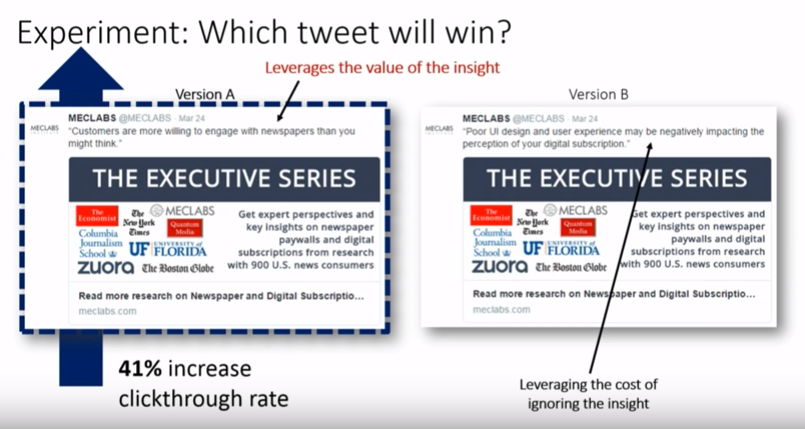
First up, two tweets.

One with a “positive, empowering message” and another that focused on the pain of potential loss. Turns out, the first fun loving one won. (Say that ten times fast.)

positive vs pain tweetImage Source

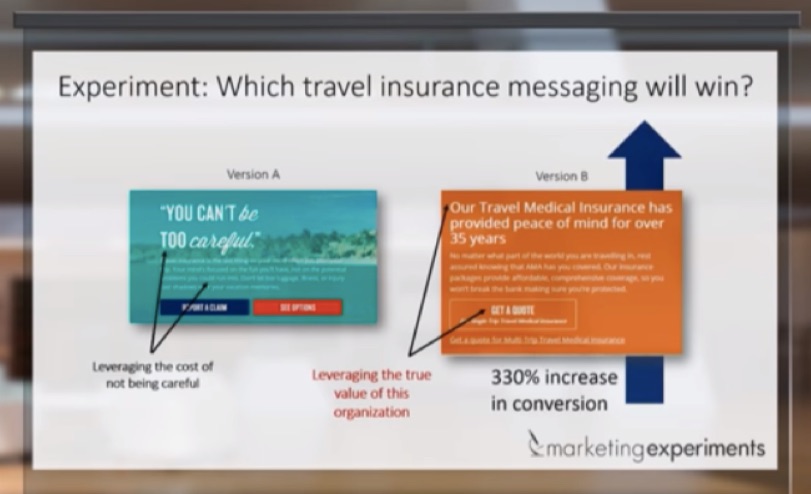
Next up, a CTA. The first was negative and fear based. The second focused on “peace of mind.”

CTA test negative vs peace of mindImage Source

Once again, the positive message was victorious.

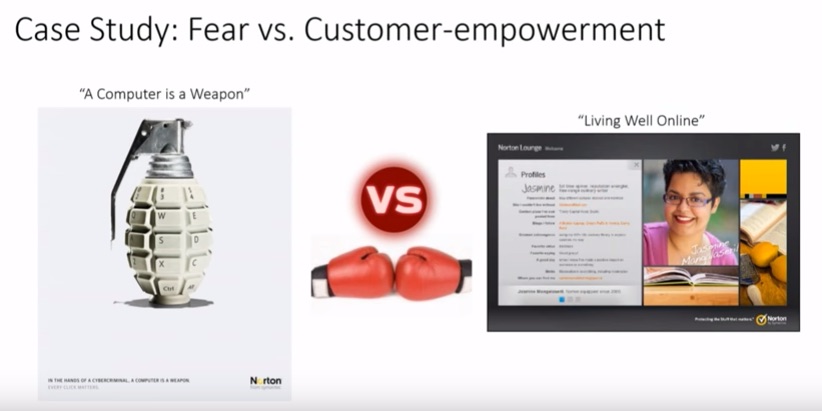
Ok one last example. Norton antivirus compared two campaigns: one that incited fear vs. another that tried to “empower” customers.

fear vs customer empowermentImage Source

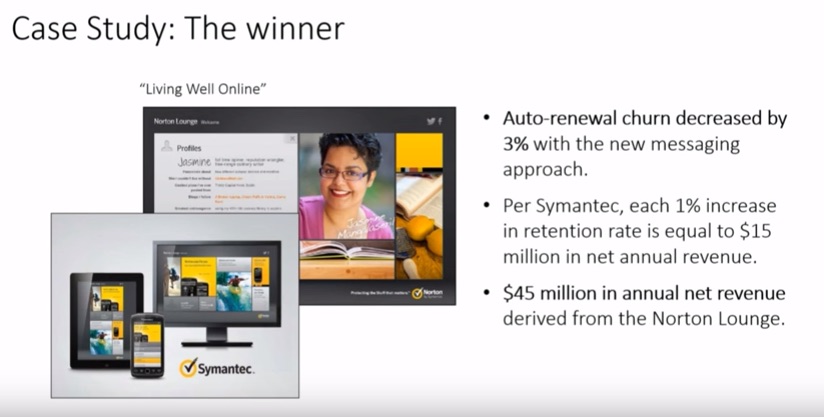
And the winner?

customer empowerment winning messageImage Source

Incredibly, the soft, touchy, feely one won. And check out that difference!

So… WTF. What’s going on? One minute fear works. And the next it doesn’t. What’s going on?

MarketingExperiments.com posits:

“The most effective marketing campaigns focus on the impact of action, rather than the result of inaction. Our goal is to create positive (non negative) momentum in the psychology of our customer’s mind.”

Turns out that while fear works wonderfully in order to first get attention, it starts to backfire when it comes to a transaction.

When you optimize for sales from customers (and not just emails or blog post headlines) the nuance appears. That context can make all the difference.

Fear can also backfire during certain times of the year. For example, the holidays. During this blissful time, positive emotions tend to fare better.

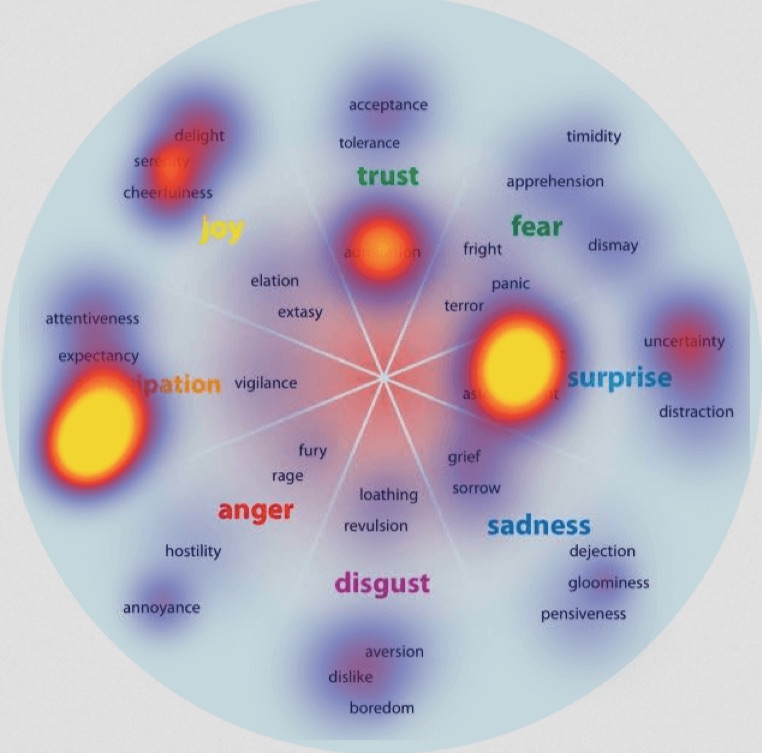
A Fractl study in the Harvard Business Review, visually illustrates this. The most shared content related most to anticipation, surprise, trust, and joy (so happiness overall). While fear-based ones were a ghost town.

most shared contentImage Source

Focusing on what people are going to get during this time pays off. (As opposed to what they might miss out on or the ‘cost of inaction’).

Why people want (to buy) reassurance

People don’t need your thing.

So there’s only one reason they buy: to solve a pain point. One that kinda bothers them but isn’t life or death.

What they don’t want, is to be disappointed. They don’t want to take a chance on your thing and be sorry they purchased it. They want to know it’s going to work like it should. It (and you) will be there when it (and you) should.

Fear mongering sometimes crosses that line. Exhibit B comes courtesy of a Gallup poll that showed car salesmen are trusted more than your local politicians (and at this rate, the White House most likely, too).

That’s why 81% of people look to peers for decision making (as opposed to branded messages).

So there’s a line. Somewhere. Under all of those fear-based headlines.

Fear works wonderfully at capturing attention. There’s almost nothing better. But… too much, too often can be harmful.

Negative messaging might pique the interest of those ‘cold’ prospects who lack need awareness (for your product or widget). Fear makes them sit up and take notice. It makes them realize — for the very first time — that they might have a problem that needs to be solved.

Outbrain ran a study on 65,000 paid links in order to find out which worked best: positive or negative messages (in syndicated ads).

The results weren’t even close. Negative ones crushed it (by 60%).

positive vs negative superlatives in titles

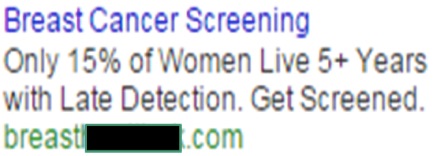
Sometimes, people need that shot of adrenaline in order to stop and pay attention.

fear based messaging in breast cancer advertisementImage Source

But ‘warmer’ ones who already ‘get it’ don’t need the same heavy-handed approach.

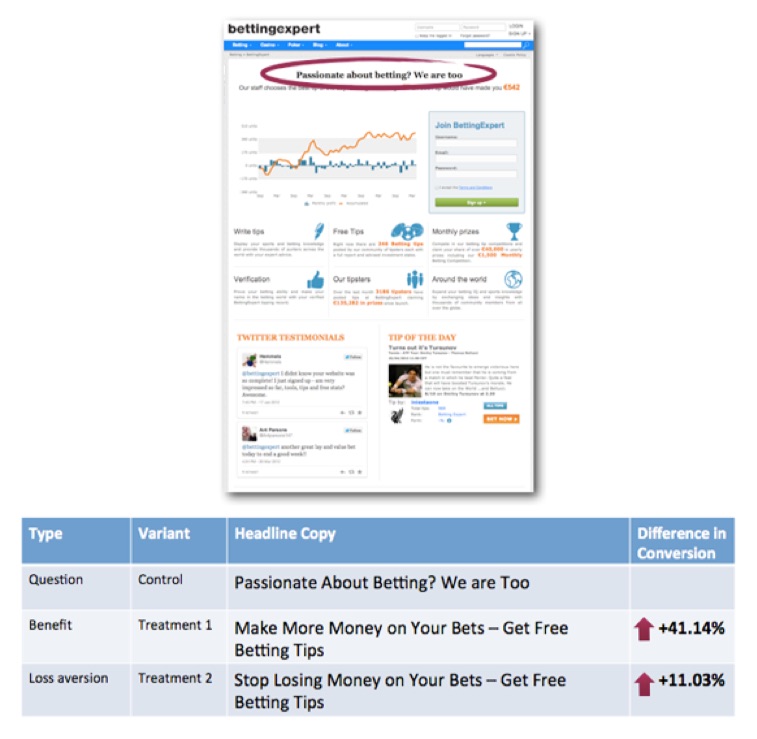
Another study compared a few different headlines. They were:

Passionate about betting? We are too. Make More Money on Your Bets — Get Free Betting Tips Stop Losing Money on Your Bets — Get Free Betting Tips

Unsurprisingly by now, the second and third (positive and negative) ones dominated the first generic one.

But… the positive message outperformed the negative one.

betting expert headline testsImage Source

The positive one focused on what people were going to get (as opposed to what they were going to lose out on).

That’s where you back off a bit. Switch the value proposition to what your widget will bring them (as opposed to what NOT having it will do to them). Otherwise it becomes overkill. And it backfires.

old sledgehammer resting on table

Conclusion

Fear-based messaging works. In many cases.

It plays upon our evolutionary biology; stimulating our fight or flight response in order to get us to take notice.

However… it also requires the right context. Many studies have shown that negative message works wonders when you’re targeting people who might be unaware of what your widget does. Unaware that they even have a problem or need for what you do in the first place.

But. When it comes to ‘warmer’ traffic who does understand, fear can backfire.

These people see through the fear mongering. They’re looking for reassurances instead. They want the truth. They want to know what they’re going to get out of it. The value or end result.

About the Author: Brad Smith is the founder of Codeless, a B2B content creation company. Frequent contributor to Kissmetrics, Unbounce, WordStream, AdEspresso, Search Engine Journal, Autopilot, and more.